
OWA Stage 2+ Vertification Achieved with High-Performance Turbulence Intensity Calibration Algorithm
Recently, Oldbaum Services has officially released an OWA Stage 2+ verification report for Blue Aspirations after conducting a systematic evaluation of wind speed, wind direction, and turbulence intensity, as measured by one ZX continuous-wave (CW) LiDAR and one WindCube pulsed LiDAR installed on its Floating LiDAR System. The results show that, across all measurement heights, the LiDAR-derived data exhibit high consistency with reference met mast measurements, and that all statistical metrics within each wind speed bin satisfy the OWA Stage 2+ evaluation criteria.
OWA Stage 2+ is a dedicated phase within the Offshore Wind Accelerator (OWA) framework, specifically designed to evaluate and assess turbulence intensity (TI) measurements obtained from Floating LiDAR wind measurement systems. The report demonstrates excellent turbulence intensity performance compared to the Inch Cape met mast in Scotland.
Previously, Blue Aspirations developed a motion-corrected turbulence intensity calibration algorithm specifically for the ZX continuous-wave LiDAR, with results already reaching Best Practice according to the CFARS Guidelines. The newly issued OWA Stage 2+ report further confirms the robustness and reliability of this turbulence calibration methodology, while also validating the newly developed turbulence calibration performance of the WindCube pulsed LiDAR.
Physics-Based Motion Compensation and Turbulence Intensity Calibration Algorithm
The report specifically verifies our motion compensation and calibration algorithm for pulsed LiDAR systems. Derived directly from Doppler measurement principles, this algorithm is based purely on physical laws and mathematical modeling.
Key features of the algorithm include:
Physics-based, thus no training data is required.
Applicable across different sea-state conditions without sea-state-specific tuning.
Supports turbulence intensity calibration for both floating and fixed pulsed LiDAR installations.
Independent of manufacturer and compatible with commonly used pulsed LiDAR systems.
The algorithm is verified in the report at a representative height of 101 m, within the wind speed range of 4–16 m/s:
Maximum mean turbulence intensity error: 0.003
(Best-practice requirement: 0.01)
Maximum representative turbulence intensity error: 0.011
(Best-practice requirement: 0.015)
And, consistently strong performance is observed across different heights, as illustrated in the evaluation results.
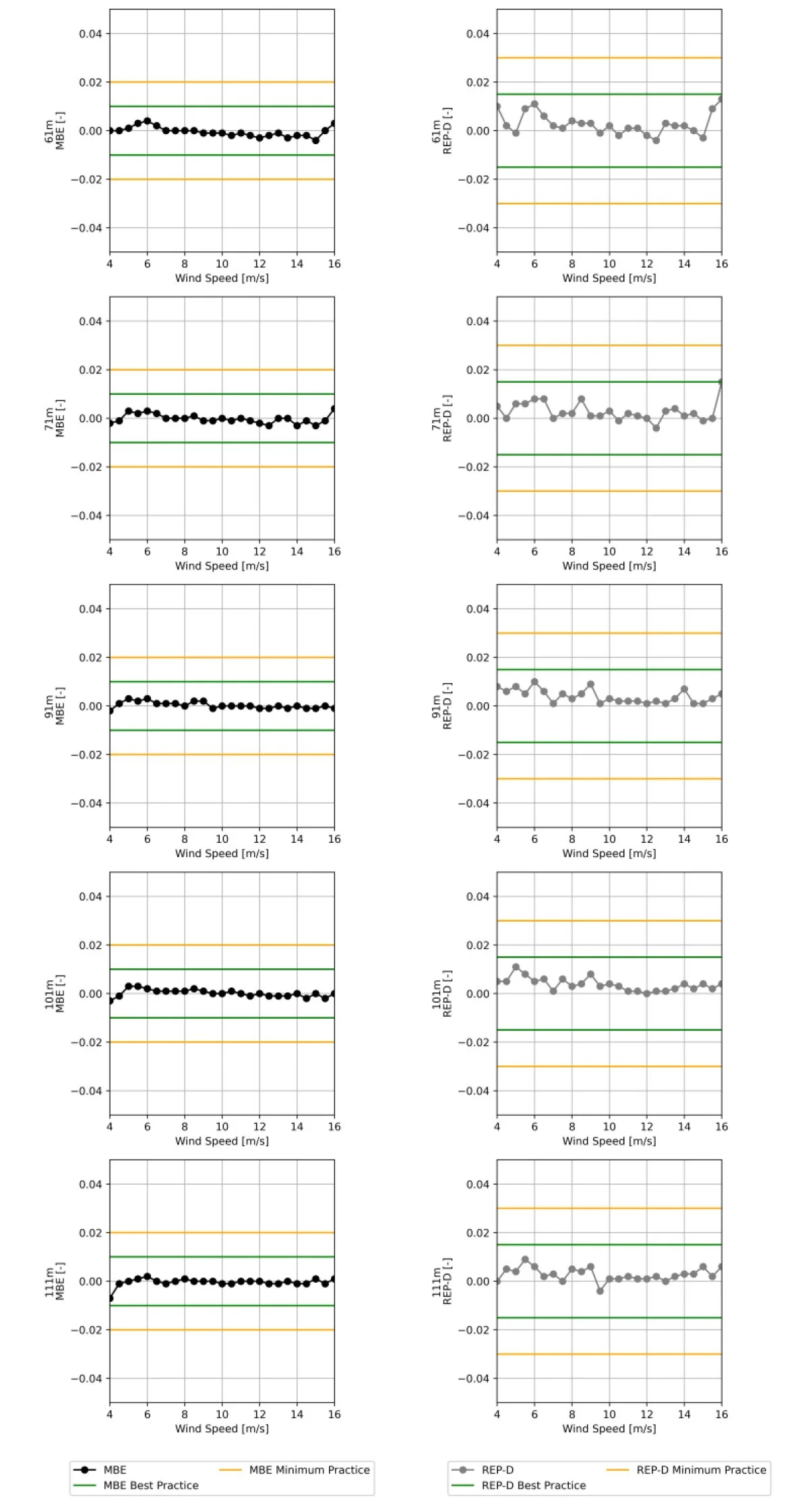
Quote from Oldbaum Services, OWA Stage 2+ Verification of BA-FLS-NX5 WindCube Measurements at Inch Cape Met Mast
With this achievement, our wind measurement solutions based on both continuous-wave LiDAR and pulsed LiDAR technologies have reached a new technical milestone, providing comprehensive and reliable support for offshore wind projects, including wind resource assessment, power forecasting, as well as operations and maintenance (O&M).